My Top 5 Projects
GitHub Projects
Programming and software development is of much interest to me and so I've compiled some of the current personal development projects I've worked on in my GitHub profile repositories. Within the main code files, I've left comments showcasing code description, challenges, and improvements which can be made. I've also included README files in each project to overview the project and running instructions. All projects/repositories can be found here: My GitHub Projects. Individual project links follow below.
My Portolio Website (this website) - My Portfolio Website Project
Calculator with Tkinter GUI (Python) - Tkinter GUI Calculator Project
OOP Console Calculator (Python) - Console Calculator Using OOP Approach Project
Weather App (Python) - Weather App Using WeatherAPI Project
Tic-Tac-Toe Game (Python) - Tic-Tac-Toe Console Game Project
Budget Tracker (Python) - Budget Tracker Console Project
Natural Language Processing OpenAI Call IVR Integration
For some context, Content Guru supply a unique software which centralizes omni-channel interactions for customers, i.e. the ability to route and receive emails, webchats, calls and more in one centralized application window - big use cases for contact centres. During my first 6 months working as a Support Engineer at Content Guru, I was working on a project to improve the accuracy of voice recognition during the IVR phase (the IVR phase is when you call a number and an automated bot says "Press 1 for ... Press 2 for ..." or "Say why you are calling" (voice recognition)) of calls for one of our large clients. The client was currently using Google and Azure voice recognition, but the accuracy of these models led to inaccurate call routing which wastes time and money for the client. They desired a solution which would make voice recognition 80% accurate for call routing as opposed to the current 65%.
Through cross-collaboration, we came up with a futuristic yet regulated solution to utilize OpenAI's ChatGPT to recognize the speech (the utterance) and translate it to signals (an intent) which we could route to different people/destinations.
Collaborating with the AI Development team, Product Management team, and Project Managers, I built an IVR which scanned and sent data from REST APIs to ChatGPT which translated and processed the utterance to return a routable intent. This led to an 86% accurate routing rate for calls.
The success of this project greatly improved customer sentiment but also led to the client buying more application licenses for more of their sites.
The Ultrasonic Levitator
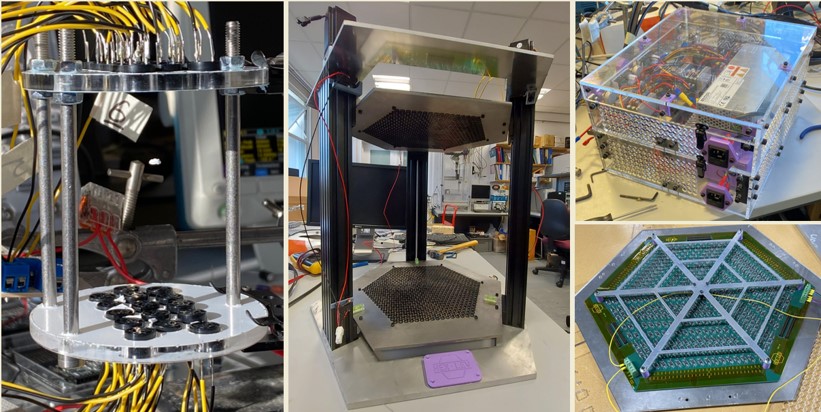
As part of an eight-member team in my final year of mechanical engineering, I worked on designing a large-scale ultrasonic levitator for the Warwick Ultrasonics Lab. Our goal was to create a levitator larger and more precise than current models, using a unique hexagonal transducer arrangement to enhance field strength and stability.
I contributed significantly to the mechanical design by proposing the hexagonal transducer pattern, which influenced the overall structure. Additionally, I conducted finite element analysis (FEA) to optimize the frame's weight and stiffness, ensuring both strength and cost-effectiveness.
During manufacturing, I played a key role in laser cutting and 3D printing components for the frame, as well as handling jet cutting and assembly of steel parts. I ensured precision in fitting transducers by expanding holes in the steel meshes, which was critical to our design.
I also gained experience in electronics and PCB design, assisting with soldering, wiring, and transducer testing. My involvement helped us achieve our first successful levitation test. Additionally, I designed temporary mounting plates for electronic components like batteries and converters.
On the project management side, I took responsibility for risk assessments and health and safety protocols, while also contributing to key documentation, such as the manufacturing plan and assembly guides. I was involved in producing animations for our project presentations and video, ensuring our work was communicated effectively.
As a result, our project met all initial objectives set and has inspired future projects and research to be conducted using the equipment we had development. This project gave me the opportunity to combine technical skills in design, manufacturing, and electronics with project management and teamwork. It was a rewarding experience that deepened my understanding of mechanical systems and sparked an interest in ultrasonic technology.
Manufacturing Management Dashboard
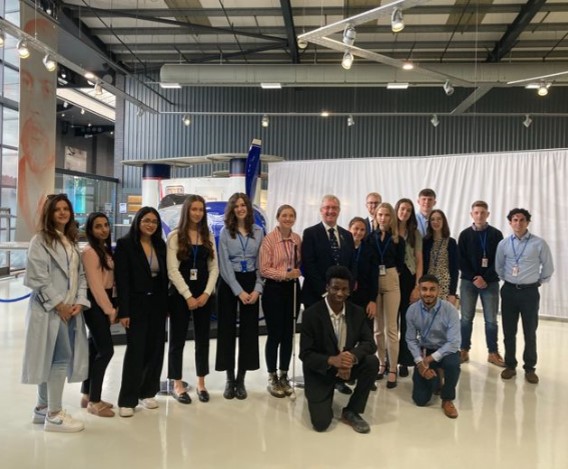
During my time at Rolls-Royce Submarines, I developed a manufacturing management dashboard using Power BI to improve the efficiency and oversight of manufacturing processes. I worked closely with key stakeholders, including the manufacturing manager, senior managers, and the manufacturing team, to understand their needs and objectives.
I transformed data on machine loading, timings, breakdowns, and maintenance into a dynamic dashboard featuring real-time machine status mapping, key manufacturing metrics, and data drilldowns. This tool helped identify production bottlenecks, provided centralized statistics, and allowed auditors to ensure performance metrics were being met.
By mastering Power BI, I applied DAX and M code to create advanced dashboard features that offered teams valuable insights into production issues, data input errors, and asset management for audits. The dashboard became integral for enhancing production plans and improving overall efficiency.
This project not only strengthened my technical skills but also developed my leadership abilities, as I took the initiative to lead discussions, challenge existing ideas, and propose new solutions that aligned with the business objectives. Collaborating with cross-functional teams also improved my ability to manage time and adapt to the dynamic needs of the business. Additionally, I gained knowledge of submarine design principles, further enriching my understanding of the industry.
Recycling 3D printed Poly-Lactic Acid (PLA)
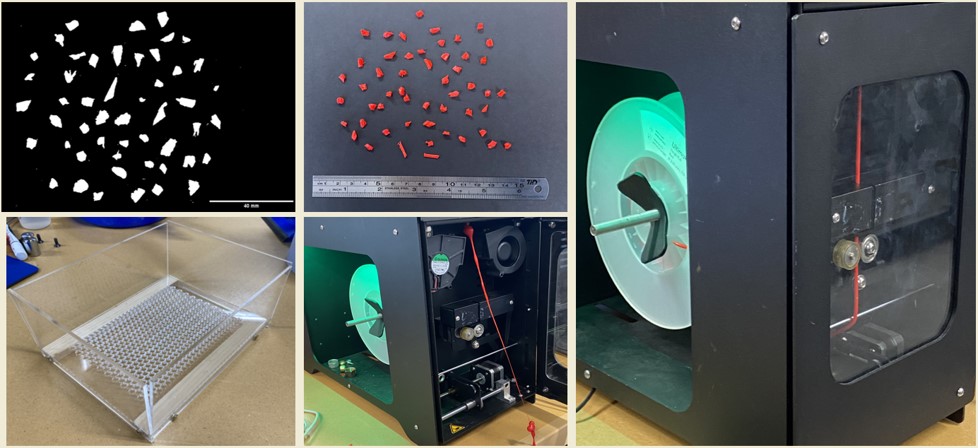
During my third year at the University of Warwick, I worked on a project to recycle 3D printed poly-lactic acid (PLA) material by developing a mechanical recycling process using a shredder and extruder. The goal was to convert used PLA prints into reusable filament. I successfully recycled the PLA into 2.85mm filament. The project also achieved significant cost savings, with a 53% higher cost-benefit than expected, potentially saving £3,471 per year if all PLA waste is recycled.
I gained valuable technical skills, including learning to design experiments and optimize processes. Using ImageJ and DevoVision software, I conducted thorough data analysis on filament characteristics, and the trial-and-error process helped refine my problem-solving and experimental design abilities. I also improved my research, design, and optimization skills.
Time management was crucial to the project's success. I used tools like the Eisenhower matrix and Gantt charts to stay on track, balancing priorities and managing stress. I experimented with different productivity techniques and found that working in two-hour focused sessions worked better than shorter intervals, enhancing my productivity and wellbeing balance.
This project not only enhanced my technical expertise but also developed key professional competencies like problem-solving, critical thinking, and ethics, aligning with IMechE and Engineering Council UK-SPEC standards. Reflecting on the project, I recognized the importance of realistic goal setting, learning from negative results and maintaining focus on both technical and personal wellbeing.